
What Gets Cut Tells the Rest. The Budget Season Audit No One Wants to Run on Themselves
Dr. John Maurice, M.C., C.T.C., M.M.C. | Blog #118

In many organizations, this is budget season. Leaders sit in rooms and say out loud what they value, and then a spreadsheet gets built. Often the spreadsheet tells a slightly different story. The distance between what an organization says matters and what it actually funds can be a clear record of which priorities survived when they had to compete with each other.
That audit is uncomfortable to run. A mission statement costs very little to write, and a budget costs something real. Every dollar that goes to one place is a dollar that didn’t go somewhere else, and a person decided that.

What I Funded and What I Left Hungry
For years I poured my time and money into creating. Books, recordings, and a blog every Sunday. All of it was visible, and all of it felt like progress. The part I funded less was getting that work in front of the people it was written for. I told myself the creating had to come first, and some of that was true.
The moment the gap became clear to me was when I paid for coaching to learn the business side of this work, an investment well over ten thousand dollars. Writing that check was the first time my spending matched something I had been saying for years, that reaching people mattered. Until then, the making got the hours and the money, because making was familiar and reaching people meant learning things I didn’t yet know. The record had been telling me something I hadn’t said out loud.

Why the Budget Often Tells the Truth Before the Mission Statement Does
A priority tends to become real when something gets given up for it. What gets funded first is often what someone was willing to protect, and what gets trimmed quietly, cycle after cycle, is often what the organization has decided can wait. Usually no one announces that decision. It builds one reasonable-sounding cut at a time.
A budget does not always show what an organization values most. A company that prizes development and hits a cash crunch may cut training to make payroll. That cut may simply show that survival outranked development under a real constraint. What the budget reveals in a case like that is which priority won when two legitimate ones collided, and that is where leadership is tested.
This is where an invisible condition becomes visible behavior and then a measurable consequence. A team hears that development matters, watches the training line shrink for a third year, and draws a conclusion about what leadership really means. Even when the cuts were forced, a team that was never told why will often fill in its own explanation. Their effort often adjusts to match it. A few quarters later the cost can show up as higher turnover or slower promotions, and it gets read as a performance problem when the earliest sign was a number in a budget.
Research on how people weigh rewards over time suggests many of us tend to favor benefits that arrive sooner over those that arrive later. That may help explain why the slower investment so often loses to the faster one, and it shows how thoughtful people can produce the pattern without meaning to.
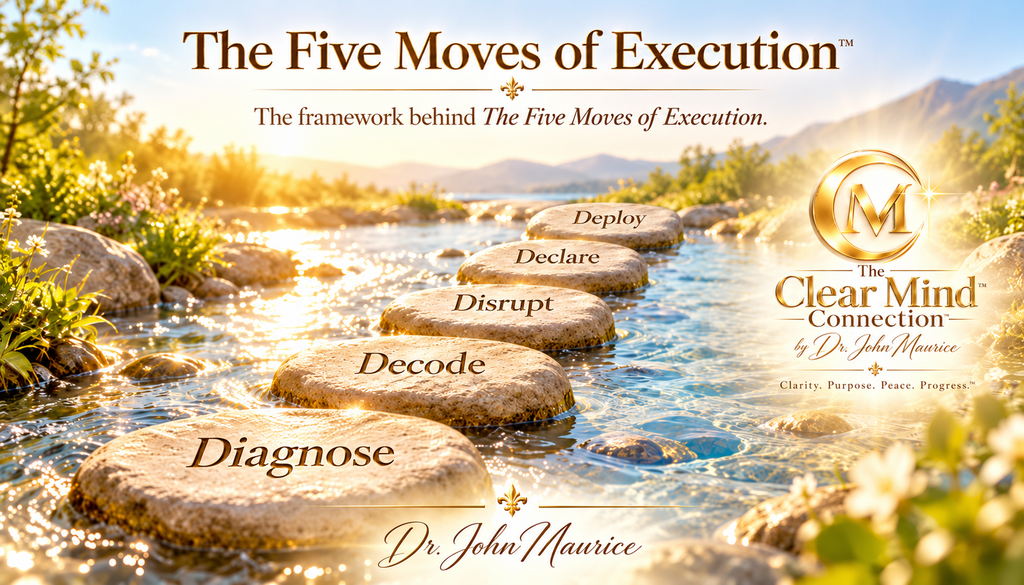
The Five Moves of Execution™
Diagnose: Put your stated priorities next to what you actually funded last cycle, in dollars and in hours. Start with what the numbers show, and leave the explanations for later.
Decode: Ask what made the gap sensible at the time. Was the real priority harder or less certain than the one that got the money? Before you judge a choice, ask what made it feel safe.
Disrupt: Stop letting the budget happen to you. Choose one priority you have named out loud and fund it first, before the easier line items get their turn.
Declare: Say, before the cycle starts, what you intend to fund and why, so what happens afterward can be checked against what you said. If something has to be cut, say why, so people don’t write their own explanation.
Deploy: Make one funding decision this cycle that matches your stated priority, even if something comfortable gets less. Then look at the result.

Knowledge Creates Possibility. Attention Determines Whether Anyone Notices in Time.
Try a simple test with your own planning documents. Take the three priorities on the strategy slide and find each one’s line in the budget. Then ask how much of the calendar those lines occupy. A priority that appears on the slide and nowhere else is telling you something.
Then ask the harder question: what are you willing to stop funding to prove that a stated priority is real? A priority that has never had to compete with anything else has not yet been tested.
The same pattern shows up in the company that says people are its greatest asset and, in a tight year, cuts development first. These are rarely acts of bad faith. They tend to be reasonable choices made under pressure, one at a time, and the pattern only becomes visible when someone lays the statement beside the spreadsheet.
Leaders can usually describe their priorities in a sentence. The discipline is checking whether the money and the calendar are telling the same story. When they aren’t, the team often notices before leadership does, and the team’s behavior tends to follow what was funded more than what was said.

Spanish Word of the Day
Invertir (een-behr-TEER)
Part of speech: Verb
Pronunciation and stress: The word is pronounced een-behr-TEER. The stress falls on the final syllable, TEER. In Spanish the letter V is pronounced much like a soft B.
Syllable breakdown: in-ver-tir → een-behr-teer
English Meaning: To invest, to put resources into something.
Simple Definition: Invertir means choosing what receives your limited resources, which also means choosing what goes without.
Examples:
Invertimos primero en lo que más valoramos.
We invest first in what we value most.
Lo que no recibe inversión se nota con el tiempo.
What receives no investment shows over time.
Invertir en las personas cuesta hoy, pero rinde mañana.
Investing in people costs today, but it pays off tomorrow.
Reflection: Where your resources go can be a record of what you decided mattered, whether or not you ever said so out loud.
Today’s Takeaway: Put what you say matters beside what you funded. Wherever the two disagree, you’ve found your next decision.

Bridge Exercise
Name the Priority: Write down the one thing you most often say matters most, in your work or your life.
Trace the Funding: List where your money and your hours actually went over the last three months.
Name the Gap: Where does the record disagree with the priority? Describe it plainly, without softening it.
Ask What Made It Rational: What made the other choices feel easier or safer at the time?
Name the Sacrifice: What would you have to stop or reduce to fund the priority properly?
Fund One Thing: Choose one decision this month that moves a real resource toward the stated priority, and put it on your calendar.

Identity Affirmation
I let my resources tell the truth about what I value. I compare what I say with what I fund, and I do it regularly. I ask what made a choice feel safe before I judge it. I am willing to stop funding something good so I can protect something essential. I would rather make one honest investment than ten comfortable ones that never mattered.

What My Own Line Items Taught Me
Once I laid my priorities beside my record, I couldn’t unsee the gap. I treated it as information about where comfort had been quietly making decisions for me, which gave me something to work with that judging myself never did.
I now ask a simple question before I commit time or money to anything: does this match what I say matters most? Some weeks the honest answer rearranges my plans. A budget that disagrees with your priorities tends to keep producing results you didn’t plan for, and one that agrees with them gives you a real chance at the results you did.

Dr. John Maurice Seal
Like always, you already know that I believe in you. And now, with you believing more in yourself, I know that I will see you on the other side of your desired reality in no time.
You are so much closer than you know. Just a few adjustments and then it is Harvesting Time.
Until next time,
Love Always,
Dr. John Maurice
M.C., C.T.C., M.M.C.

Decoding With Dr. John Maurice™
This is the section where I tell you what I am actually saying in this blog.
Deciding where to put limited resources, when several priorities are competing for them, is not the work of a single brain region making a choice. It is better understood as a distributed process in which several interacting systems weigh costs and rewards against timing and past experience.
The prefrontal cortex, the region right behind your forehead, is heavily involved in weighing trade-offs and holding a long-term goal in mind while other options pull at you. In my own teaching, I sometimes call this the Third Eye, the part of you that sees clearly and chooses with intention. That is my own plain-language name for it, not a scientific term. The real, scientific name is the prefrontal cortex.
The anterior midcingulate cortex is a region associated with effort-based decision-making and with persisting toward a goal when the payoff is uncertain or far away. That matters here because the harder, slower investment often asks for more effort now and returns the reward later. In my own teaching, I call this the Warrior of Obedience, again my own translation, not a replacement for the real term, which is the anterior midcingulate cortex.
These systems interact continuously, and none of them decides the outcome alone. When a harder investment has repeatedly felt less rewarding in the moment than an easier one, the easier choice tends to win more often, and the pattern can settle in without anyone choosing it on purpose. That pattern is learned, which is why I ask leaders to investigate before they label.
You have a framework now for seeing what most organizations miss. Diagnose what is happening. Decode what made it rational. Disrupt the pattern. Declare the new standard. Deploy the behavior that makes that standard believable. This is the system I created, The Clear Mind Connection™, and it is the same process I have used on my own budget.

The Clear Mind Connection™
For organizations navigating planning cycles, resource allocation, and the gap between stated priorities and funded ones, I bring The Clear Mind Connection™ and The Five Moves of Execution™ into corporate keynotes, executive conversations, and leadership-development experiences. This same framework, Diagnose, Decode, Disrupt, Declare, Deploy, is taught across four books: the Clear Mind Connection trilogy, If You Change Your Mind, You Can Change Your Life, Delay Does Not Mean Denial, and SHINE, and now The Five Moves of Execution™, the first book published directly under The Clear Mind Connection™ banner. You can get all four on Amazon.com. And the blog goes up every Sunday at 9AM PST, but you can catch up anytime at www.iamjohnmaurice.com.
I believe leaders can learn to let their budgets tell the truth on purpose. And once they do, they can stop confessing by accident.
Until next time,
Love Always,
Dr. John Maurice
M.C., C.T.C., M.M.C.


