
What Leaders Miss When They Wait for the Collapse to Call It a Problem
Dr. John Maurice, M.C., C.T.C., M.M.C. | Blog #117

Many failures that look sudden had an earlier moment when somebody saw something small. A wall that comes down has often shown a crack beforehand, and organizations tend to follow a similar course. The resignation or the missed quarter frequently has a quiet precursor that someone noticed and decided was not yet worth raising.
Most leaders are trained to respond well once a problem is undeniable. Fewer are trained to act while the problem is still small, which is usually when acting costs the least.

The Sign I Saw and Did Not Name
More than once while building this work, I started something with real momentum and then began to see early signs that it was thinning. Fewer people were involved and less money was coming in. I saw those signs. I told myself it was a slow season and kept building as though nothing had changed, because naming the problem out loud would have meant deciding what to do about it.
A few months later the project stalled, and I moved on to something new. The new thing felt like a fresh start, and it took me a long time to see that it was a continuation of the same pattern. I hadn’t failed to notice anything. I had watched the signs arrive and kept them to myself, and that was the step that cost me.

Why a Small Sign Gets Explained Away
Naming an early sign carries a price. It can mean admitting that something might be wrong, asking for help before you are sure, or being the person who raised an alarm that turns out to be small. Staying quiet usually feels cheaper in the moment, so a small sign gets filed under “probably nothing” and the days continue.
Sociologist Diane Vaughan studied the Challenger disaster and described what she called normalization of deviance. Her account is richer than a story of people ignoring warnings. Organizational routines, the way evidence was interpreted, and the institutional setting gradually made earlier anomalies look acceptable. No one made a reckless decision on a single day. A series of reasonable-looking acceptances added up.
This is how an invisible condition becomes visible behavior and then a measurable consequence. A team learns that small concerns are met with a shrug. People stop raising them, and a few quarters later the cost appears as a missed deadline or a lost client. By then the cheap fix usually belongs to an earlier version of the problem.
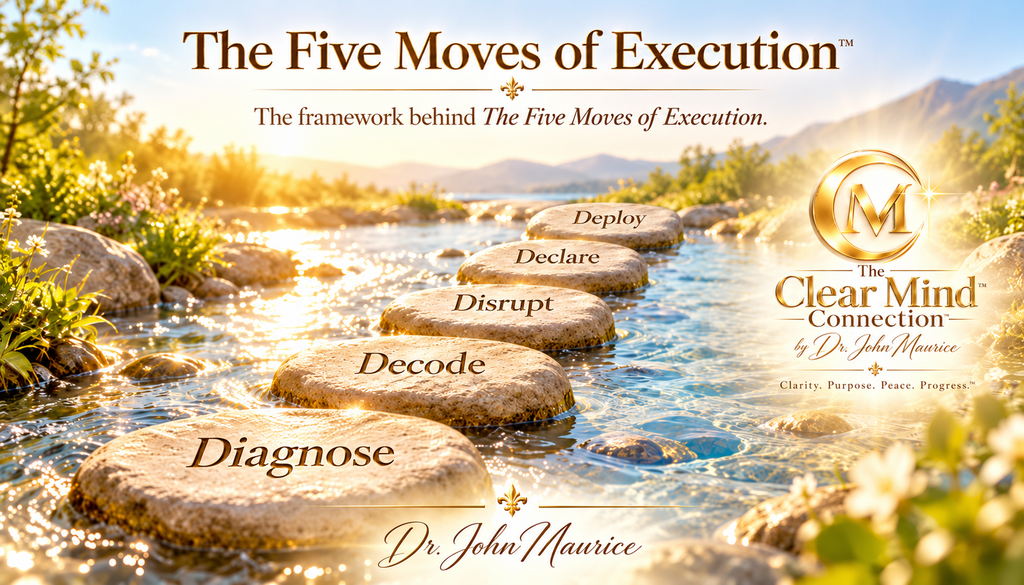
The Five Moves of Execution™
Diagnose: What small sign have you been explaining away? Write it in one specific sentence, using only what you have actually seen. If you lead others, add a harder question: what signs have stopped reaching you?
Decode: Ask what made it feel reasonable to wait. Often the honest answer is that raising it would have cost something at the time, such as an awkward conversation or an admission. If you lead others, ask what your environment has taught people about the cost of telling the truth early. Before you judge the delay, ask what made it feel safe.
Disrupt: Say the sign out loud to one other person within a day of noticing it, before you have time to talk yourself out of it.
Declare: State what you will do about it and by when, so it stops being a private worry and becomes a commitment someone else can see.
Deploy: Take the smallest useful action this week. The first honest step is often enough to change what happens next.

Knowledge Creates Possibility. Attention Determines Whether Anyone Notices in Time.
Consider a manager who notices that a strong performer’s handoffs have started to slip, or a leader who sees that a long-standing client’s replies have gotten shorter. Or a team where people used to ask questions in meetings and now sit quietly. Each of these is small, and each is usually easier to raise as a question today than as a problem next quarter.
Leaders cannot predict which small signs will matter. What they can shape is whether small signs reach them at all. Every time someone brings a weak signal, the leader’s response teaches the organization whether the next one should arrive. A team that sees early signs welcomed tends to bring more of them forward, and a team that sees them dismissed tends to bring fewer.
Over time, a leader can come to believe they see reality clearly when they are actually seeing the portion their culture has learned is safe to report. Your reaction to yesterday’s crack often shapes whether anyone shows you tomorrow’s. Leaders get the most from their attention when they build a system in which reality reaches them while it is still inexpensive to change.

Spanish Word of the Day
Notar (noh-TAHR)
Part of speech: Verb
Pronunciation and stress: The word is pronounced noh-TAHR. The stress falls on the final syllable, TAHR.
Syllable breakdown: no-tar → noh-tahr
English Meaning: To notice, to become aware of something.
Simple Definition: Notar means letting yourself register what you already sense.
Examples:
Lo noté desde el principio, pero no dije nada.
I noticed it from the beginning, but I said nothing.
Si lo notas temprano, cuesta menos arreglarlo.
If you notice it early, it costs less to fix.
Notar algo también es una decisión.
Noticing something is also a decision.
Reflection: Many cracks are visible long before the wall falls. The harder part is letting yourself look at one while it is still small.
Today’s Takeaway: Pick one small thing you have noticed and haven’t said out loud. Say it to one person this week.

Bridge Exercise
Name the Sign: Write down one small early sign you have noticed but not raised.
Trace the Delay: How long have you known? Write the date as best you can.
Ask What Made It Rational: What made waiting feel safer at the time?
Estimate the Cost: If this sign is pointing at a real problem, what would it cost to address it now compared with a year from now?
Check Your Response: Think of the last time someone brought you early bad news. What did your tone and your first question teach them about bringing you the next one?
Say It Out Loud: Choose one person and one day this week to tell them what you have noticed.

Identity Affirmation
I pay attention to small signs and I say what I see. I ask what made a delay feel reasonable before I judge it. I act while the fix is still inexpensive. I respond to early news in a way that makes the next piece of news easier to bring. I would rather raise a small concern today than explain a large one later.

What That Pattern Taught Me
The part I keep returning to is that the information was always there. What I lacked was the habit of saying it out loud to someone who could help me look at it. Once I started naming early signs within a day of seeing them, the conversations got smaller, shorter, and far less expensive.
Seeing early is a skill many of us already have. The part worth practicing is the next step, where what you see turns into something you say, and where what you hear from others is received in a way that keeps the information coming.

Dr. John Maurice Seal
Like always, you already know that I believe in you. And now, with you believing more in yourself, I know that I will see you on the other side of your desired reality in no time.
You are so much closer than you know. Just a few adjustments — and it is Harvesting Time.
Until next time,
Love Always,
Dr. John Maurice
M.C., C.T.C., M.M.C.

Decoding With Dr. John Maurice™
This is the section where I tell you what I am actually saying in this blog.
Deciding whether to raise an early concern or let it pass is not the work of a single brain region. It is better understood as a distributed process in which several interacting systems weigh possible costs, possible benefits, and what past experience has taught.
The prefrontal cortex, the region right behind your forehead, is heavily involved in planning, weighing consequences, and judging whether an action is worth its cost. In my own teaching, I sometimes call this the Third Eye, the part of you that sees clearly and chooses with intention. That is my own plain-language name for it, not a scientific term. The real, scientific name is the prefrontal cortex.
The amygdala, a small, almond-shaped structure deep in the brain, is closely associated with detecting threat and emotionally significant information, and research suggests it can respond to a troubling signal quickly, sometimes before conscious reasoning has caught up. It works as one part of a rapid-response system and does not decide anything alone. In my own teaching, I call this the Fear Filter, again my own translation, not a replacement for the real word, which is the amygdala.
These systems interact continuously. When someone has repeatedly seen that raising a concern early is met with a shrug or a cost, waiting can start to feel like the sensible choice, and that pattern can build gradually over time. Neuroscience is only part of the picture here. Research in organizational behavior on psychological safety and employee voice points to how much leadership responses can shape what people are willing to say. The pattern reflects what a person has learned an environment rewards, which is why I ask leaders to investigate before they label.

The Clear Mind Connection™
You have a framework now for seeing what most organizations miss. Diagnose what is happening. Decode what made it rational. Disrupt the pattern. Declare the new standard. Deploy the behavior that makes that standard believable. This is the system I created, The Clear Mind Connection™, and it is the same process I have had to use on myself.
For organizations navigating early warning signs, quiet risk, and the habit of raising concerns before they become expensive, I bring The Clear Mind Connection™ and The Five Moves of Execution™ into corporate keynotes, executive conversations, and leadership-development experiences. This same framework, Diagnose, Decode, Disrupt, Declare, Deploy, is taught across four books: the Clear Mind Connection trilogy, If You Change Your Mind, You Can Change Your Life, Delay Does Not Mean Denial, and SHINE, and now The Five Moves of Execution™, the first book published directly under The Clear Mind Connection™ banner. You can get all four on Amazon.com. And the blog goes up every Sunday at 9AM PST, but you can catch up anytime at www.iamjohnmaurice.com.
I believe leaders can learn to say what they see while it is still small, and to build rooms where others do the same. And once they do, they get to choose the inexpensive fix.
Until next time,
Love Always,
Dr. John Maurice
M.C., C.T.C., M.M.C.


