
Dr. John Maurice, M.C., C.T.C., M.M.C. | Blog #112
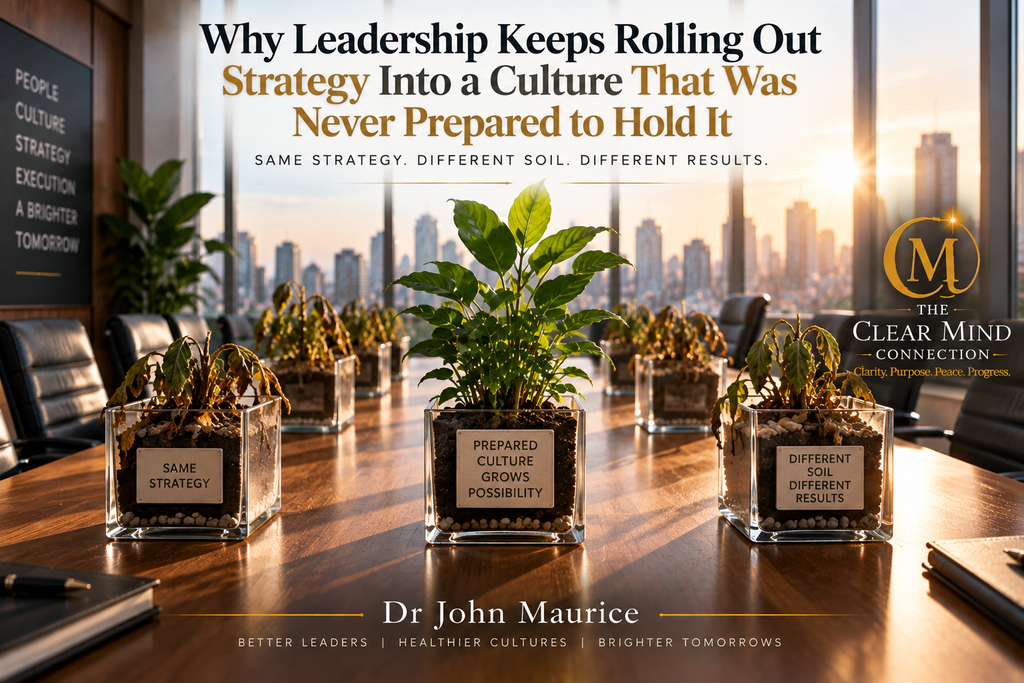
What I have learned being a owner of a few companies is when a strategy fails, organizations usually look first at the most visible explanations. Perhaps the plan was wrong. Perhaps the communication was unclear. Perhaps managers did not reinforce it strongly enough. Perhaps the team lacked urgency, accountability, or commitment. Those explanations may occasionally contain part of the truth, but they often miss the deeper problem: leadership keeps planting new strategy into organizational soil it has never prepared to hold what it is asking people to grow.
A company can provide the training, introduce the technology, redesign the process, hold the town hall, distribute the presentation, announce the new priorities, and still watch execution stall. The reason is not always resistance to the strategy itself. Sometimes the new strategy is competing with something leadership never addressed underneath it: burnout from the previous transformation, mistrust created by an abandoned initiative, fear produced by repeated restructuring, cynicism after promises that were never fulfilled, or an unwritten cultural rule telling employees that keeping their heads down is safer than challenging the status quo.
These conditions have business consequences. They affect how quickly people adopt change, whether leaders receive honest information, how much discretionary effort employees are willing to contribute, whether accountability feels credible, and ultimately whether strategy becomes behavior. Culture is not something sitting beside execution. Culture is one of the conditions through which execution either becomes possible or becomes painfully expensive.
That is why one of the most dangerous questions leadership can ask after disappointing results is, “Why won’t our people execute the strategy?” A better question is, “What was already growing in this organization before we planted the strategy?”
That question changes the conversation.

A Good Seed in Unturned Soil Can Still Produce a Harvest, Just Not the One You Intended
I learned this principle personally before I learned to articulate it organizationally. For more than four years, I worked relentlessly on the body of work I believed would prepare me for the next level of my career. I wrote three books. I built an extensive archive of weekly teachings. I studied, created, experimented, refined, and continued showing up even when the visible results did not yet resemble the future I knew I was building toward.
The problem was not effort. The problem was the belief underneath the effort.
I had quietly accepted the idea that enough discipline could eventually substitute for the right investment, the right environment, and the right individualized guidance. That belief did not look like fear. It looked responsible. It looked resourceful. It even looked admirable because I could point to the amount of work I was doing as evidence that I was moving forward.
Eventually I had to confront something more difficult: I was producing a harvest, but not the harvest I actually wanted.
That realization led me to make a significant investment in an environment specifically designed to challenge the assumptions, positioning, and systems that my own effort had been unable to see clearly. The investment was not an admission that the previous work had been wasted. It was recognition that hard work cannot compensate forever for conditions that are not capable of supporting the next level of growth.
Organizations make the same mistake every day. They assume another training, another communication campaign, another leadership meeting, another set of goals, or another software platform will produce the breakthrough. Sometimes those investments are necessary. But when the conditions underneath them remain untouched, leadership keeps asking a new strategy to defeat an old culture without ever addressing the culture directly.
A good seed cannot negotiate with the soil.
Every Organization Has Something Growing Beneath the Strategy
Weeds do not wait for permission. Neither do organizational habits.
If an organization has learned through experience that new initiatives are eventually abandoned, employees will naturally become cautious about investing themselves fully in the next one. If managers have repeatedly been punished for bringing difficult information upward, silence becomes rational. If employees have survived years of doing more with less, another message about transformation may not sound inspiring. It may sound like another demand placed on an already depleted system.
That is why culture cannot be diagnosed from mission statements, values posters, or leadership presentations alone. Culture is revealed in repeated behavior. It is what happens when the meeting ends, when the leader leaves the room, when the deadline becomes uncomfortable, when a mistake occurs, when someone challenges an assumption, and when doing the right thing competes with doing the politically safe thing.
Every organization is growing something. The leadership question is whether what is growing beneath the surface supports the future being announced from the stage.
In 2026, this question has become increasingly important because organizations are simultaneously navigating economic pressure, AI adoption, workforce change, trust challenges, and demands for stronger leadership capability. Current CHRO research places leadership and manager development at the top of organizational priorities, while workplace culture has also risen sharply in importance.
The issue is no longer whether companies need better strategy. The issue is whether their leaders know how to prepare human systems to execute strategy under pressure.
Stop Diagnosing the Seed When the Problem Is in the Soil
For years I was asking myself a question that sounded reasonable: “Why is this not working yet?” That question kept my attention on the result.
A more useful question finally emerged: “What is already growing here that I have never challenged?”
For me, the answer was the belief that working harder could indefinitely compensate for investing differently. Inside an organization, the answer may be very different. It may be an unspoken belief that leadership will not listen. It may be a history of initiatives beginning with excitement and disappearing without explanation. It may be a management culture in which vulnerability is punished, accountability is inconsistent, or employees have learned that visibility creates risk.
These beliefs rarely announce themselves formally. Nobody places them in the employee handbook. They exist because repeated experience taught people what to expect. That distinction matters because people do not execute strategy according to what leadership alone says. They also execute according to what their experience has taught them is safe, rewarded, realistic, and worth believing.
This is why organizations can experience what appears to be a motivation problem when they actually have a trust problem, an accountability problem when they actually have a clarity problem, or a change-resistance problem when they actually have a history problem. If leadership diagnoses the wrong problem, it can spend extraordinary amounts of money solving something that was never broken.
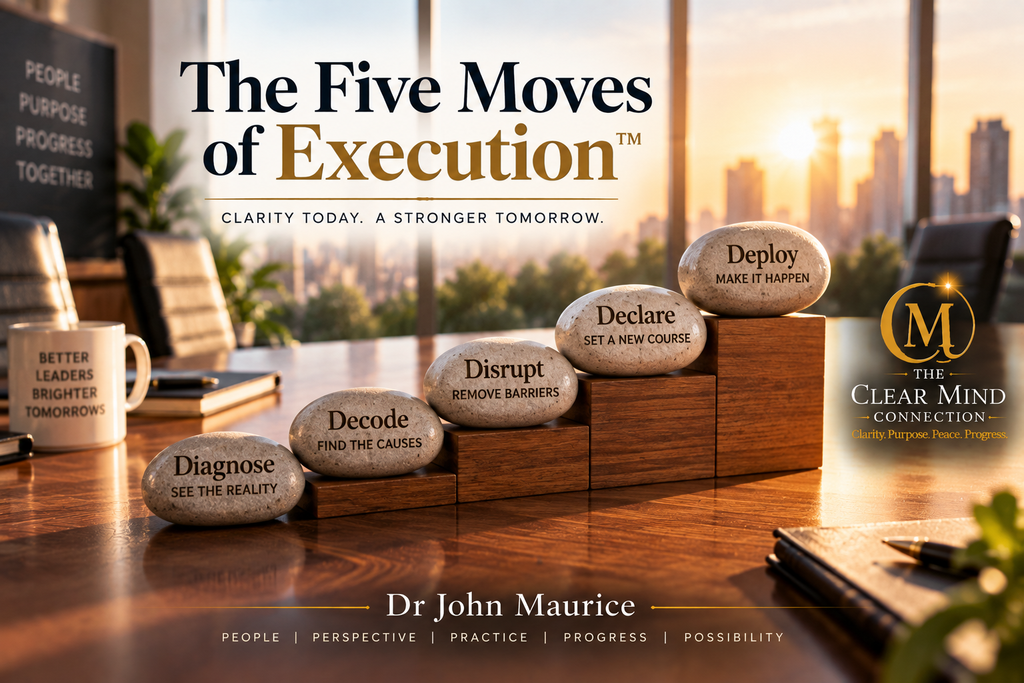
The Five Moves of Execution™
This is where the framework I teach becomes practical for leadership teams. Sustainable execution requires more than telling people what needs to change. It requires leaders to understand what is currently shaping behavior and then deliberately change the conditions supporting that behavior.
Diagnose: Before introducing another solution, identify what is actually preventing execution. Ask where the friction appears, what leaders are observing repeatedly, and what employees may have learned from previous experiences. Diagnose the pattern without immediately assigning blame.
Decode: Patterns have origins. Determine what belief, experience, incentive, leadership behavior, or cultural condition is sustaining what you diagnosed. If employees do not trust the new initiative, ask what previous experience taught them not to trust it. If managers avoid accountability conversations, ask what the organization has historically rewarded or punished when those conversations occurred.
Disrupt: Once the pattern is visible, leadership must interrupt it deliberately. New language without new behavior is not disruption. If leadership wants transparency, leaders must demonstrate what happens when someone tells an uncomfortable truth. If the organization wants innovation, employees must see that intelligent experimentation will not be punished simply because every experiment does not succeed.
Declare: Leaders must define the new standard clearly enough that people can recognize it in behavior. “We value accountability” is an aspiration. “We address missed commitments directly, respectfully, and within forty-eight hours” is a behavioral standard. Culture changes when values become observable.
Deploy: The new standard must move from communication into action. Resources, incentives, leadership behavior, meeting structures, performance expectations, and decision-making must reinforce the culture being declared. Deployment is where aspiration finally becomes evidence.
Diagnose. Decode. Disrupt. Declare. Deploy. That is how leadership moves from announcing transformation to creating the conditions capable of sustaining it. The Five Moves are already embedded in the framework I have been developing through my work; the corporate application simply makes explicit what the original framework was already designed to accomplish.

Knowledge Creates Possibility. Conditions Determine Whether It Can Grow.
Companies invest heavily in knowledge. They train people. They hire consultants. They build presentations. They introduce methodologies. They send executives to conferences. They teach managers new competencies.
Knowledge matters, but knowledge does not operate in a vacuum. A leader may intellectually understand how to give feedback and still avoid the conversation because the organizational culture has taught that leader conflict is dangerous. A team may understand a new strategy perfectly and still hesitate to commit because the previous three strategies disappeared before the team could see meaningful results. An executive may tell people to “challenge the status quo” while unconsciously rewarding those who agree quickly and penalizing those who ask difficult questions.
The gap between knowing and doing is where culture lives. This is one reason leadership development cannot end with information transfer. Organizations need leaders who can examine the conditions influencing behavior, confront the assumptions sitting underneath performance, and create environments in which the desired behavior becomes easier to practice consistently.
Current leadership-development research supports the commercial importance of that challenge: Harvard Business Impact reports that 42% of organizations procure leadership-development programs externally, while scalability, transformation, and high-impact learning remain important considerations in program selection.
The opportunity for leadership is therefore larger than teaching another skill. It is helping people convert understanding into behavior.
Stop Managing What Keeps Growing Back

Spanish Word of the Day
Arrancar (ah-rrahn-KAHR)
Part of speech: Verb
Pronunciation and stress: The word is pronounced ah-rrahn-KAHR. The stress falls on the final syllable, KAHR, so let that last sound land with weight when you say it.
English Meaning: To uproot, to pull out by the root, to tear away.
Simple Definition: Arrancar isn’t gentle. It’s not trimming what’s visible on the surface. It means going down to where the root actually lives and removing it entirely, so it can’t grow back the same way.
Examples:
No basta con cortar la maleza. Hay que arrancarla.
It’s not enough to cut the weeds. You have to uproot them.
Arranqué de raíz la creencia que me había frenado durante tres años.
I uprooted the belief that had been holding me back for three years.
Un equipo no cambia hasta que arranca lo que lo detiene.
A team doesn’t change until it uproots what’s holding it back.
Reflection: You can mow a weed down every week and it will keep coming back, because cutting isn’t the same as removing the root. Arrancar is the word for finally going deep enough that it doesn’t grow back the same way. Management reduces what you can see. Uprooting changes what can grow back. That is true personally, and it is equally true organizationally.
Today’s Takeaway: Stop managing what keeps growing back. Arrancar it. Stop becoming excellent at managing symptoms your culture keeps reproducing.

Bridge Exercise
Identify the Ground: Think about one area, personal or professional, where your team or company keeps getting a result you didn’t plant for, no matter how much effort or strategy you pour into it.
Examine the Growth: Write down what you believe is actually growing there, underneath the surface effort. Not the convenient excuse, but the real, unspoken belief, fear, history, or behavioral pattern that has been sitting in that organizational soil unnamed.
Trace the Origin: Ask where it came from. What past experience or failed transformation initiative planted it? What did that event teach your team to believe was true about leadership commitments or accountability?
Plan the Uprooting: Write down exactly what it would take to uproot it, not manage around it or mask it with a new meeting, but remove it entirely. Read what you wrote out loud this week and prepare to have that uncomfortable conversation with your leadership team.

Identity Affirmation
I don’t just plant strategy; I examine what is already growing in the environment first. Before I blame my team’s effort, I examine the conditions surrounding their execution. I am willing to invest in creating the structural conditions that support performance instead of simply demanding harder work from conditions that undermine it. I uproot the unspoken cultural patterns that keep reproducing resistance rather than becoming excellent at managing their symptoms. I diagnose clearly, decode courageously, disrupt intentionally, declare specifically, and deploy consistently. I lead, I build, and I execute from soil I have been willing to turn.
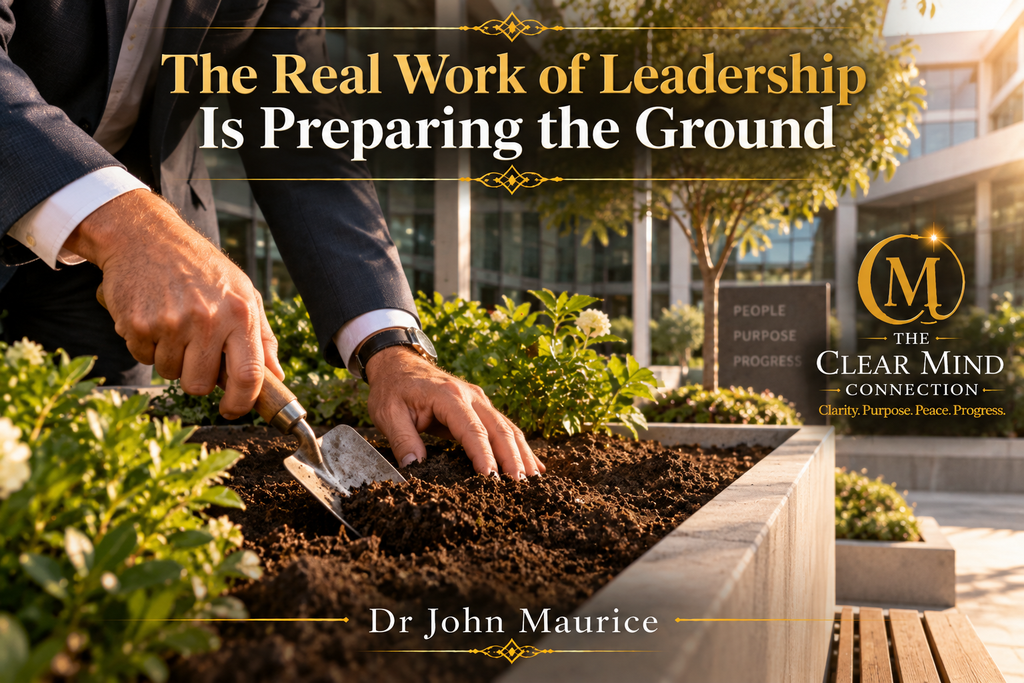
The Real Work of Leadership Is Preparing the Ground
I do not regret the years I spent building before I recognized what was missing. Those years developed discipline, created a body of work, and taught me lessons I could not have learned through theory alone. But they also taught me something I now believe applies far beyond my own story: consistent effort in the wrong conditions will eventually place a ceiling on what that effort can produce.
The investment I eventually made did not invalidate the work that came before it. It prepared the conditions for that work to grow differently.
Leadership functions the same way. Sometimes your people do not need another motivational speech. Sometimes they do not need another strategy presentation. Sometimes they do not need another reminder to work harder.
Sometimes leadership needs the courage to look beneath the strategy and ask what the organization has been cultivating without realizing it.
Because when a team repeatedly produces a disappointing harvest, the most important leadership question may not be, “What is wrong with our people?” It may be, “What have we been growing here?”
That question can change an organization because it moves leadership away from blame and toward responsibility. It changes the conversation from motivation to conditions, from symptoms to systems, and from demanding execution to creating an environment in which execution can actually take root.

Dr. John Maurice Seal
Like always, you already know that I believe in you. And now, with you believing more in yourself, I know that I will see you on the other side of your desired reality in no time.
You are so much closer than you know. Just a few adjustments, and it is Harvesting Time.
Until next time,
Love Always,
Dr. John Maurice
M.C., C.T.C., M.M.C.

Decoding With Dr. John Maurice™
Decoding With Dr. John Maurice™
This is where I tell you what I am actually saying beneath the metaphor.
Your brain has different parts that handle different jobs, and understanding something in your head doesn’t always mean your body and habits catch up right away. That’s normal. That’s not a character flaw. It’s how the brain actually works.
The prefrontal cortex is the part of your brain right behind your forehead. It’s in charge of planning, thinking things through, and making good decisions instead of reacting on impulse. In my own teaching, I sometimes call this part what spirituality calls the Third Eye, because in a lot of spiritual traditions, that’s the name for the part of you that sees clearly and thinks before reacting. That’s just my own way of describing it, not a scientific term, the real, scientific name is the prefrontal cortex.
The amygdala is a small part of your brain that acts like an alarm system. Its job is to notice danger and warn you fast, before you’ve even had time to think it through. That’s useful when there’s real danger. The problem is, it can also sound the alarm over something that just feels unfamiliar or uncomfortable, even when it’s not actually dangerous, like trying something new, or trusting someone again after being let down before. In my own teaching, I call this the Fear Filter, again, my own plain-language name for it, not a replacement for the real word, which is the amygdala, a small, almond-shaped structure sitting deep inside the brain.
The anterior midcingulate cortex, or aMCC, is the part of your brain that kicks in when something is hard and you have to push through it anyway. It’s the part responsible for effort, willpower, and staying with something difficult instead of quitting. That’s the part doing the work every time you choose to keep going even though it would be easier to stop.
So here’s how it actually works together. The prefrontal cortex makes the plan. The amygdala can sound a false alarm and make that plan feel scary or unsafe. And the aMCC is what lets you keep moving forward anyway, even while that alarm is still going off. Real, lasting change happens when all three are working together, not when one of them shuts the others down.
“You have a framework now for seeing what most organizations miss. Diagnose what is happening. Decode what is sustaining it. Disrupt the pattern. Declare the new standard. Deploy the behavior that makes that standard believable. This is the system I created, The Clear Mind Connection™, and it’s the same process I worked through to get here myself.”
The question is no longer simply whether your strategy is good enough. The question is whether the environment surrounding that strategy is prepared to support what you are asking people to become, believe, and execute.

For organizations navigating transformation, change fatigue, leadership alignment, cultural friction, or the persistent gap between strategy and execution, I bring The Clear Mind Connection™ and The Five Moves of Execution™ into corporate keynotes, executive conversations, and leadership-development experiences designed to help leaders examine what is growing beneath their strategy before asking their people to execute another one.
This same framework, Diagnose, Decode, Disrupt, Declare, Deploy, is taught in full across The Clear Mind Connection trilogy: If You Change Your Mind, You Can Change Your Life, Delay Does Not Mean Denial, and SHINE, available now on Amazon.com. And every Sunday at 9AM PST, a new teaching continues the conversation at www.iamjohnmaurice.com.
I believe leaders can change what they are willing to see clearly. And when leadership changes the conditions beneath performance, the organization finally has an opportunity to produce a different harvest.
Until next time,
Love Always,
Dr. John Maurice
M.C., C.T.C., M.M.C.